Is Bahia Palace worth visiting?

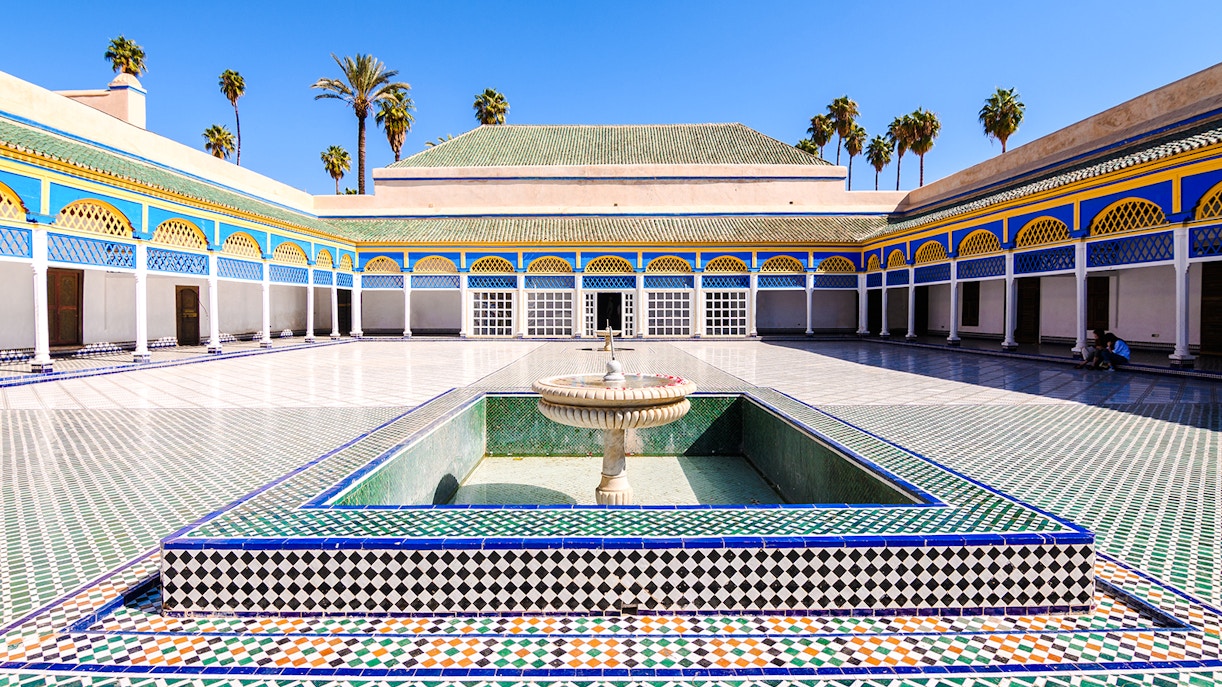
Marrakesh can be sensory overload, but Bahia Palace offers a different kind of intensity; one of silent, rhythmic beauty. Walking through the Grand Courtyard feels like stepping into a kaleidoscope; the white Carrara marble reflects the fierce Moroccan sun against vibrant yellow and blue wooden galleries.

The palace was built to embody "brilliance," and it delivers the emotional payoff of a lived-in history. Unlike a museum with glass cases, here you walk through the actual harem rooms and council chambers where the political fate of Morocco was decided. You can almost feel the presence of the 160 wives and concubines who once inhabited these hushed, jasmine-scented quarters.

The emotional payoff is the sheer mastery of craft. It is rare to see wood, stone, and tile harmonized so perfectly. Most visitors leave with a deep appreciation for the "slow art" of the Fassi artisans.

Skip it if: You have under 60 minutes or are looking for a museum with artifacts and furniture. The rooms are empty; the architecture itself is the exhibit.

What to see at Bahia Palace?

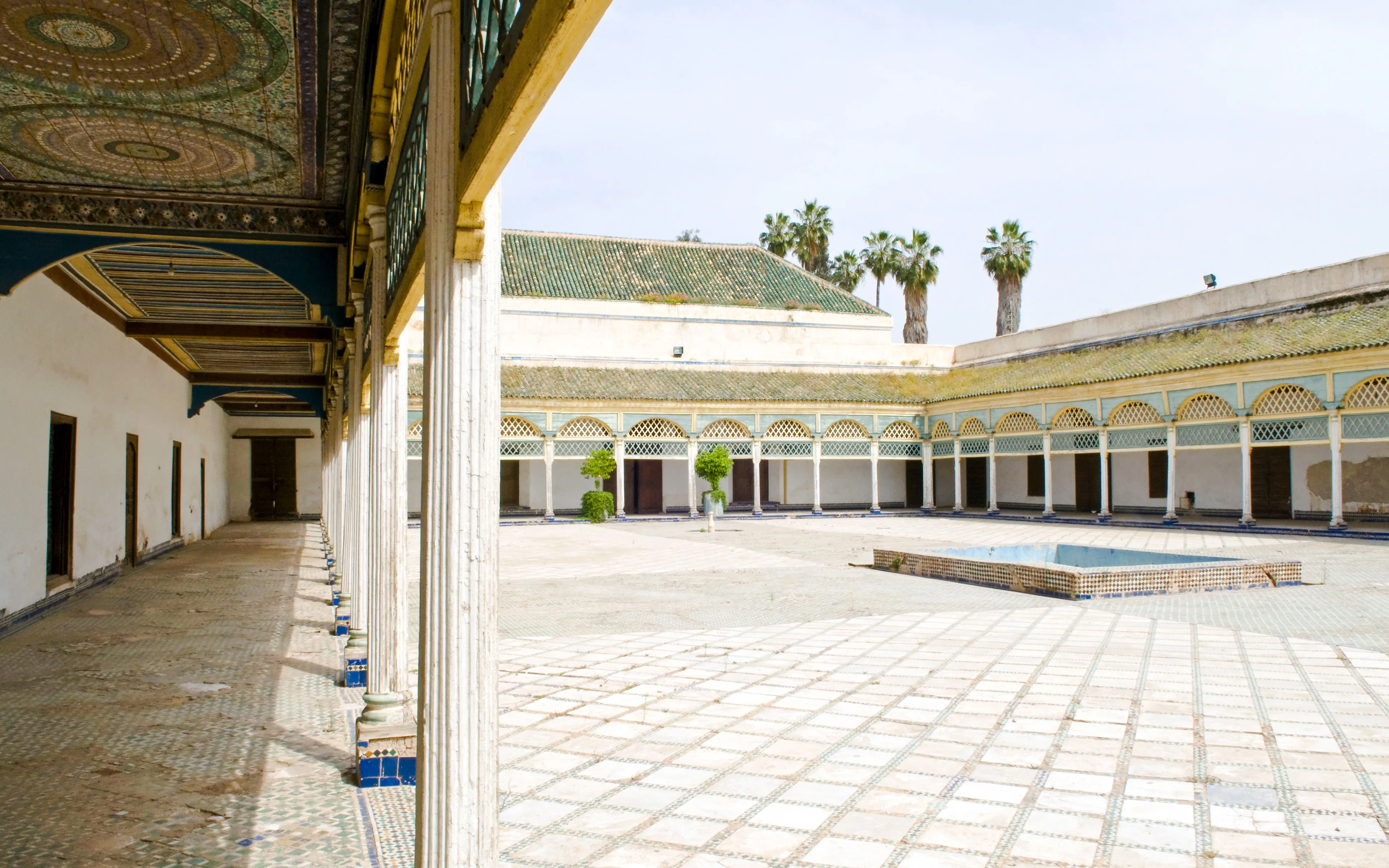
Bahia Palace courtyard with arched colonnade and tiled floor in Marrakech.
Tour group listening to a guide at Bahia Palace, Marrakech.
Bahia Palace intricate arch and carved wood details, Marrakech.
Tourist walking through tiled corridor in Bahia Palace, Marrakech, Morocco.
Bahia Palace courtyard with intricate tilework and green arched doors in Marrakesh.
1/5

The Grand Courtyard (Cour d'Honneur)

The palace’s most iconic zone. This massive 1,500 $m^2$ plaza is paved in Italian marble and framed by 52 carved wooden columns. It was the public "waiting room" for the Vizier’s guests. This area draws more visitors than any other; most spend 20 minutes here just capturing the symmetry.

The Petit Riad

The heart of the private palace. This enclosed garden features a traditional four-part layout with citrus trees and fountains. Look for the "zouak" painted ceilings in the surrounding rooms; the floral motifs are still vibrant over a century later.

The Council Chamber

The most opulent room in the complex. This is where state affairs were handled. The ceiling is a masterclass in cedarwood carving, and the stained-glass windows filter light into colorful geometric patterns across the floor.

The Harem Quarters

A series of residential rooms for the Vizier’s four wives and dozens of concubines. The room of Lalla Zinab (the favorite wife) is a standout, featuring the most refined plasterwork in the palace. Most visitors walk through these quickly, but the ceiling details here reward slow looking.

The Grand Riad (Dar Si Moussa)

The oldest section of the palace. It feels more "pastoral" and overgrown than the formal marble areas. The niches in the walls here once held the most precious books and perfumes belonging to the Vizier’s father.

How to explore Bahia Palace

Bahia Palace courtyard with fountain and colorful tilework in Marrakech, Morocco.

Budget a minimum of 90 minutes; 2 hours if you want to explore the gardens and the older Grand Riad section. The site is a literal labyrinth designed to keep the Vizier’s private life hidden from the public.

Suggested route: Enter through the long garden path and start with the Petit Riad to see the finest carvings while you are fresh. Move directly to the Grand Courtyard before the midday sun makes the marble too bright. End your visit in the Harem Quarters and the Grand Riad, which lead naturally toward the exit.

  • Must-see: Grand Courtyard, Council Chamber, Petit Riad.
  • Optional: The far northern gardens are peaceful but offer less architectural detail if you are short on time.

Guided vs. Self-paced: A guide is highly recommended. Because there are no information plaques, you will miss the scandalous history of the Viziers and the hidden symbolism in the tile patterns without someone to narrate the experience.

Brief history of Bahia Palace

  • 1866: Si Moussa, a former slave who rose to become Grand Vizier, begins construction on the "Grand Riad" section.
  • 1894: His son, Ba Ahmed, takes power and begins a massive expansion to house his four wives and 24 concubines, creating the palace we see today.
  • 1900: Ba Ahmed dies. The palace is immediately looted by Sultan Abdelaziz’s guards, who carry away all portable treasures.
  • 1908: Pasha Thami El Glaoui takes over the palace as a residence for his guests.
  • 1912: During the French Protectorate, it becomes the official residence of the French Resident-General, Lyautey, who adds fireplaces and electricity.
  • Today: The palace is a national monument and a state venue, still used occasionally by the Moroccan Royal Family for visiting dignitaries.

Architecture of Bahia Palace

Style: Islamic-Moorish / Moroccan. The architecture is a "living catalog" of 19th-century Moroccan craft, blending Andalusian influence with North African materials.

Materials: The palace utilizes "Zellij" (geometric mosaic tile), "Gebs" (hand-carved plaster), and "Zouak" (painted cedarwood). The Grand Courtyard’s marble was specifically imported from Carrara, Italy, to signal the Vizier's immense wealth.

Feats of Engineering: The palace was designed as a series of ventilation "lungs." The placement of riads (interior gardens) ensures that a cool breeze circulates through the thick-walled rooms even when the Marrakesh heat hits 40°C.

Who built it? The palace was the vision of two men: Si Moussa and his son Ba Ahmed. While no single architect is credited, the work was executed by thousands of master artisans from Fes. Ba Ahmed’s philosophy was one of "calculated opulence;" he wanted to eclipse the Sultan’s own palaces to reflect his status as the true power behind the throne.

Frequently asked questions about Bahia Palace

Yes. It is the most complete example of a royal residence in Marrakesh. While the rooms are empty of furniture, the "permanent art" on the walls and ceilings is world-class and worth the entry price alone.