Quick Information

RECOMMENDED DURATION

1 hour

VISITORS PER YEAR

500000

EXPECTED WAIT TIME - STANDARD

30-60 mins (Peak), 0-30 mins (Off Peak)

EXPECTED WAIT TIME - SKIP THE LINE

0-30 mins (Peak), 0-30 mins (Off Peak)

UNESCO YEAR

1985

Plan your visit

Did you know?

The tombs were not accidentally forgotten — they were deliberately sealed. Sultan Moulay Ismail (1672–1727) had the entrance walled up to suppress the memory of the Saadian dynasty. It was only when a French aerial survey in 1917 noticed unusual shadows in the Kasbah that the site was rediscovered and excavated.

Several of the graves in the outdoor courtyard belong to Jewish royal advisors — reflecting the Saadian sultan's practice of appointing Jews to high positions of trust in his court. This makes the site one of the rare royal necropoles in Morocco where Muslims and Jews were buried together.

Despite being built by the same sultan (Ahmad al-Mansur) who built El Badi Palace, the Saadian Tombs were not stripped by Moulay Ismail. The reason, historians believe, is superstition: desecrating tombs was considered spiritually dangerous even for a sultan determined to erase his predecessors.

Is Saadian Tombs worth visiting?

Inside the Kasbah, the noise of Marrakech drops away fast. You step through a narrow entrance into a garden of sun-warmed stone, quiet graves, and rooms so finely worked that your eyes keep moving from tile to cedar to carved plaster. It feels less like a monument and more like finding a royal secret that the city somehow kept.

The complex was built in the late 16th century as the burial place of the Saadian dynasty, above all Sultan Ahmad al-Mansur’s family line. That purpose still shapes the experience: these are not grand public halls, but intimate spaces designed to honor power, memory, and dynastic prestige.

The payoff is closeness. You are inches from Carrara marble columns, gilded cedar ceilings, and tombs that carry real human weight, not just postcard scale. Few sites in Marrakech feel this detailed and this hushed.

Skip it if: You dislike tight interiors, queuing for popular rooms, or standing for most of the visit.

What to see inside the Saadian Tombs?

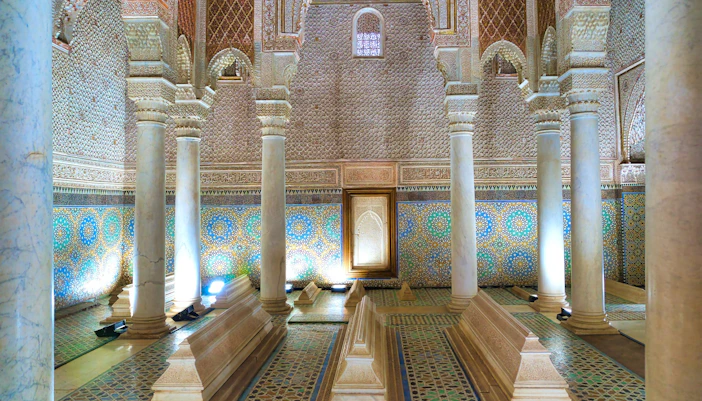
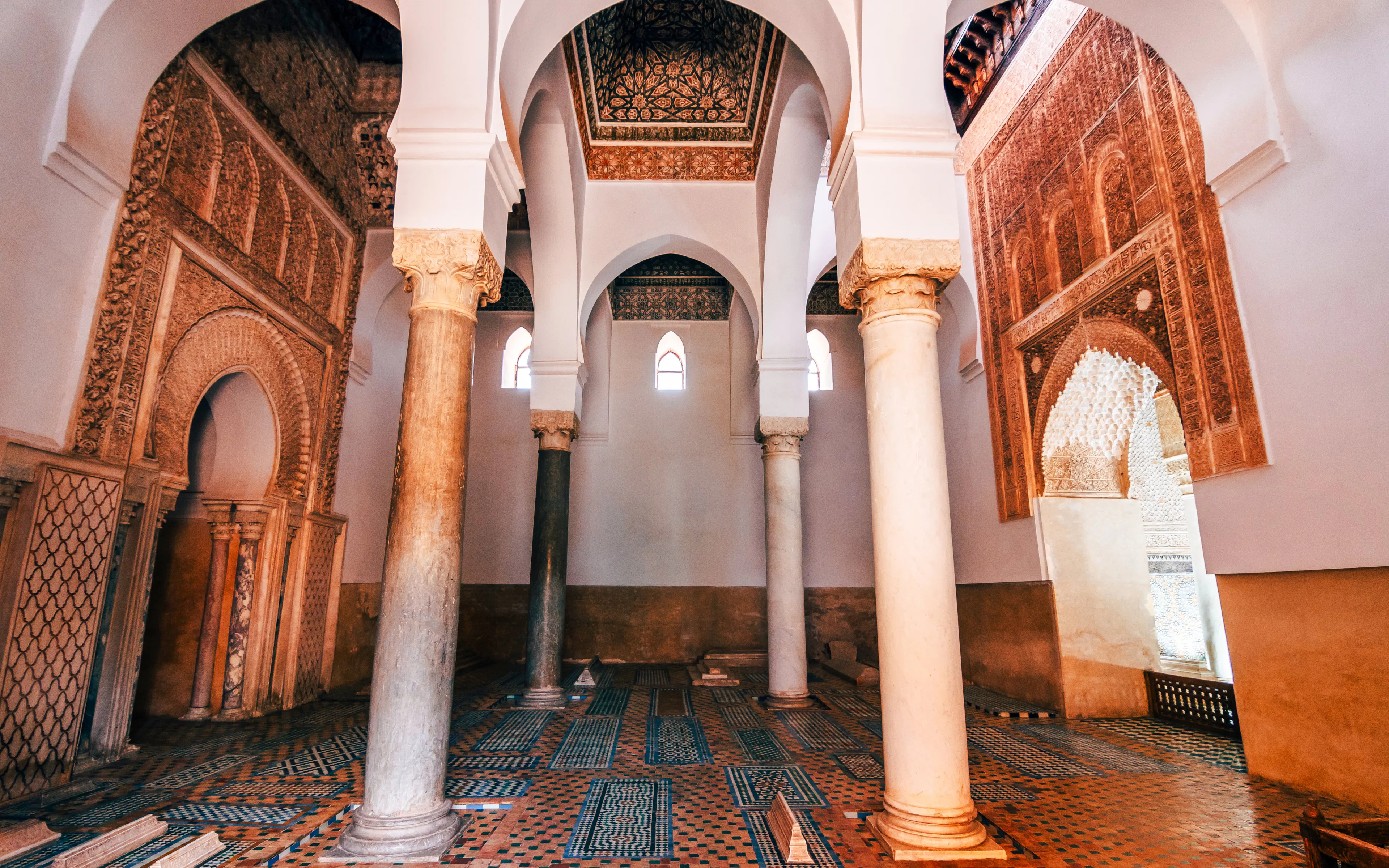
Chamber of the Twelve Columns
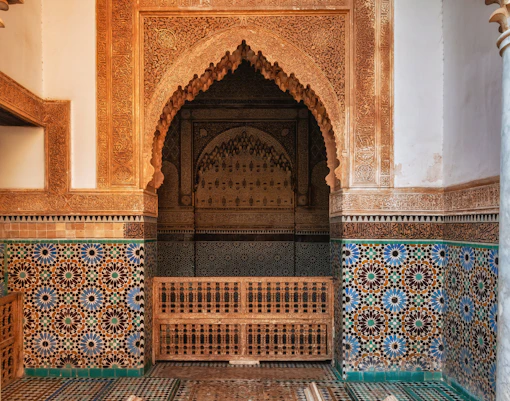
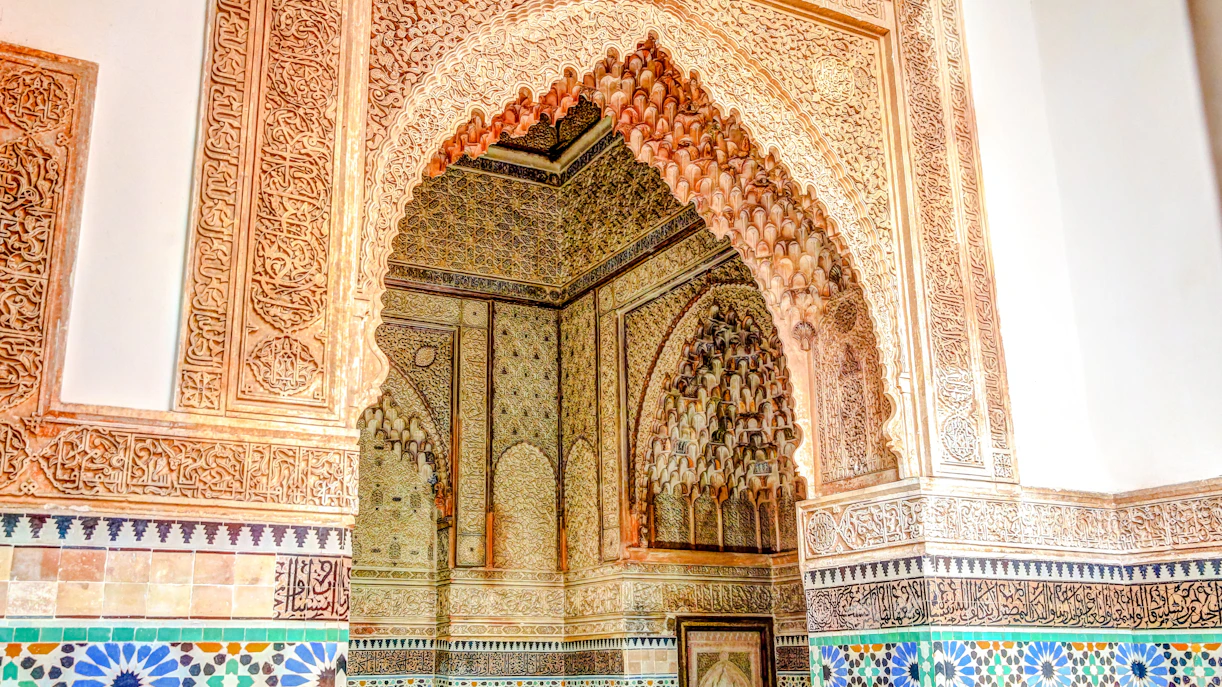
Mihrab Hall at the Saadian Tombs
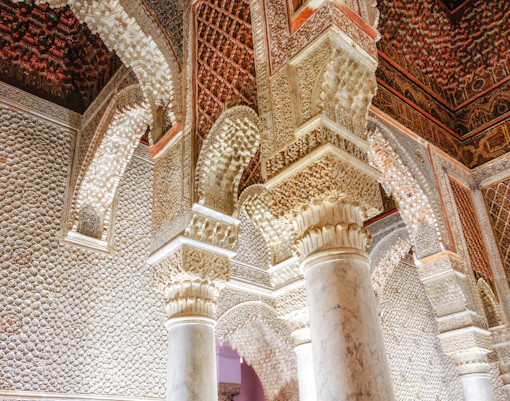
Chamber of the Three Niches
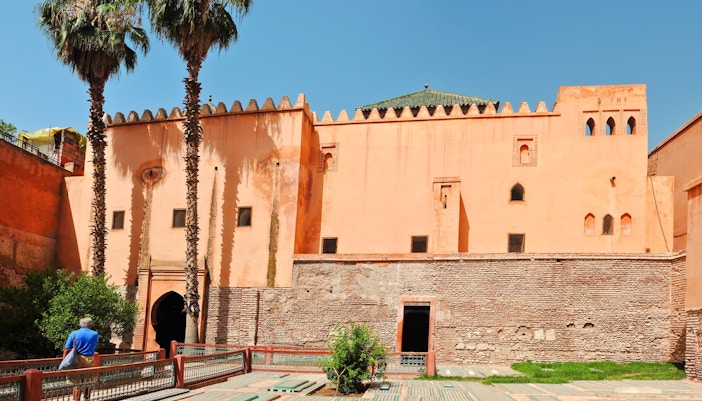
Garden tombs at the Saadian Tombs
1/4

Chamber of the Twelve Columns

The main mausoleum of Ahmad al-Mansur, framed by 12 Carrara-marble columns and a gilded cedar ceiling. This is the room most people wait for, so arrive early or late in the day for a clearer view.

Mihrab Hall

Look for the carved prayer niche, Quranic inscriptions, and the tomb of Lalla Mas'uda, al-Mansur’s mother. The chamber is smaller than the centerpiece, but its calm, gold-toned ceiling holds your attention longer.

Chamber of the Three Niches

This annex is more restrained, with 3 recessed burial spaces linked to royal wives and children. After the richness of the main hall, its symmetry and quieter decoration make the family story feel more personal.

Garden tombs

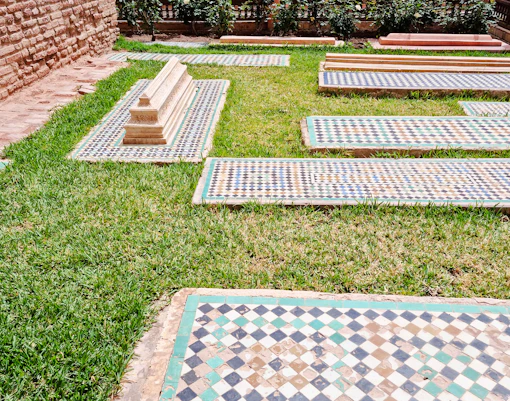
Between the mausoleums, low graves sit among paths, flowers, and green-tiled markers. Slow down here: the garden explains the scale of the dynasty, not just its rulers, and it is usually the quietest part of the visit.

Without local context, the tombs can feel brief and easy to misread

The Bahia Palace, Saadian Tombs, Koutoubia and Souks Guided Tour connects the mausoleums to palace politics, Kasbah history, and medina life, while the ticket-inclusive option removes entry logistics.

How to explore the Saadian Tombs

How to explore the Saadian Tombs

Budget 30–45 minutes for the tombs alone, or about 1.5–2 hours if you pair them with nearby El Badi Palace or Bahia Palace. The visit stays short because the complex is compact, but lines at the entrance and around the Hall of Twelve Columns can slow you down.

Start with the garden courtyard to get your bearings, then move to the Chamber of the Twelve Columns before crowd buildup blocks the sightlines through the doorway. Continue to the Mihrab Hall for the carved prayer niche and Lalla Mas'uda’s tomb, then finish in the Chamber of the Three Niches, where the scale drops and the family story becomes easier to follow. End with a slow lap around the garden graves before you leave the Kasbah quarter.

Must-see: Chamber of the Twelve Columns, Mihrab Hall, and the garden tombs. Optional: pair the visit with El Badi Palace for rooftop views and imperial scale, or Bahia Palace for courtyards and residential palace interiors; either adds about 45–60 minutes. Self-paced works well here, but a guided tour adds real value because the dynastic relationships and symbolism are not obvious from the plaques alone.
Brief history of Saadian Tombs

  • 1578: Sultan Ahmad al-Mansur comes to power and begins shaping a dynastic burial complex beside the Kasbah Mosque to honor Saadian rulers and legitimize his reign.
  • Late 16th century: The most ornate mausoleums, including the Chamber of the Twelve Columns, are completed with Carrara marble, zellij, carved plaster, and gilded cedar.
  • 1603: Ahmad al-Mansur is buried here, confirming the site as the royal necropolis of the Saadian dynasty.
  • Late 17th century: Under the Alaouite ruler Moulay Ismail, the tombs are sealed off behind walls and fall out of public view for centuries.
  • 1917: French authorities rediscover the complex, beginning documentation and restoration.
  • Today: The tombs are one of Marrakech’s most important Saadian monuments and reopened to visitors after restoration and earthquake-related repairs.

Who built Saadian Tombs?

The Saadian Tombs were commissioned by Sultan Ahmad al-Mansur in the late 16th century as a dynastic mausoleum for his family line. The project was political as well as funerary: its lavish materials and courtly decoration turned burial into a statement of Saadian legitimacy, wealth, and imperial ambition.

Although no named architect is attached to the complex, the tombs were created under Ahmad al-Mansur’s court and financed as a royal statement. The imported marble, gilded cedar, and meticulous stucco were chosen to make Saadian memory look permanent, refined, and unmistakably imperial.

Architecture of the Saadian Tombs

Style

Moroccan-Andalusian funerary architecture that feels inward, hushed, and intensely decorative, with richly worked chambers opening from a quiet garden rather than a monumental public facade.

Materials

Carrara marble, carved plaster, zellij tile, and cedar wood dominate the interiors, so your eye keeps shifting between cool stone, glossy geometry, and warm gold-toned ceilings.

Structure

The Hall of Twelve Columns is the engineering showpiece, using imported marble columns and arches to frame a gilded muqarnas ceiling over the royal tombs.

On the ground

Because the complex is compact, you notice craftsmanship at arm’s length — Kufic inscriptions, carved niches, and subtle differences between royal chambers and simpler garden graves.

Why the Saadian Tombs stayed hidden for centuries

What preserves the Saadian Tombs also explains their strange aura today. After the Saadian dynasty fell, the Alaouite ruler Moulay Ismail did not destroy the necropolis; instead, he blocked access and built around it, leaving only a narrow passage from the Kasbah Mosque side. That decision kept the mausoleums out of sight for roughly 2 centuries and spared much of their ornament from the constant reuse that stripped other historic buildings. When you visit now, that sense of accidental survival is part of the experience.

Frequently asked questions about the Saadian Tombs

Yes. The tombs are one of Marrakech’s most rewarding short visits, especially if you care about architecture, dynastic history, or quieter monuments. Pair them with Bahia Palace, Saadian Tombs, Koutoubia and Souks Guided Tour for stronger historical context.

More reads