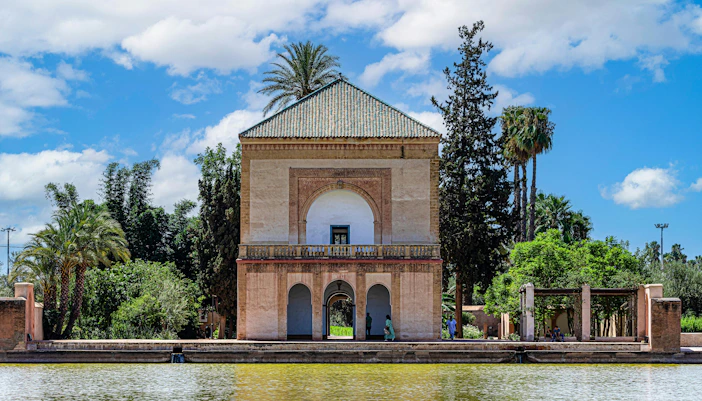
Austere Alaouite pavilion architecture, built to frame a landscape rather than dominate it. The low mass and steep roof push your attention outward to water, groves, and mountains.
Quick Information
RECOMMENDED DURATION
1 hour
Timings
08:00–18:00
EXPECTED WAIT TIME - STANDARD
0-30 mins (Peak), 0-30 mins (Off Peak)
UNESCO YEAR
1985
Did you know?
The pavilion itself has no secondary ticket checkpoint. Research says delays are usually caused by vehicle congestion near the garden gate, especially around sunset, rather than by lines at the monument.
Peak sunset can turn a short stop into a longer outing: total visit congestion is estimated at 40–90 minutes then, compared with about 20–40 minutes off-peak.
Menara Pavilion is close to Marrakesh Airport for a heritage stop. The research places it about 5–7 km away, or roughly 10–20 minutes by taxi.
Is the Menara Pavilion worth visiting?
You leave the traffic behind, follow a dusty path through olive trees, and the space suddenly opens into a broad basin of still water. The pavilion’s green roof, ocher walls, and, on a clear day, the Atlas horizon give Menara a calm, horizontal grandeur that feels very different from Marrakesh’s compressed medina.
Menara was created as a royal orchard and reservoir, built to control water as much as to create beauty. That purpose still defines the place: the basin, the groves, and the pavilion all make sense as parts of a working landscape shaped by dynasties, not a decorative park.
The payoff is not spectacle but release. You come here for space, light, and the rare feeling of watching Marrakesh slow down, with local families, reflections on the water, and long views that city palaces cannot offer.
Skip it if: you want richly furnished interiors or struggle with exposed walking in heat, because the experience depends on an outdoor approach and a simple pavilion.
What to see at the Menara Pavilion?
1/7
The approach through the olive groves
The walk in is part of the experience: straight lanes, dusty ground, and rows of olive trees that make the basin feel more dramatic when it finally appears.
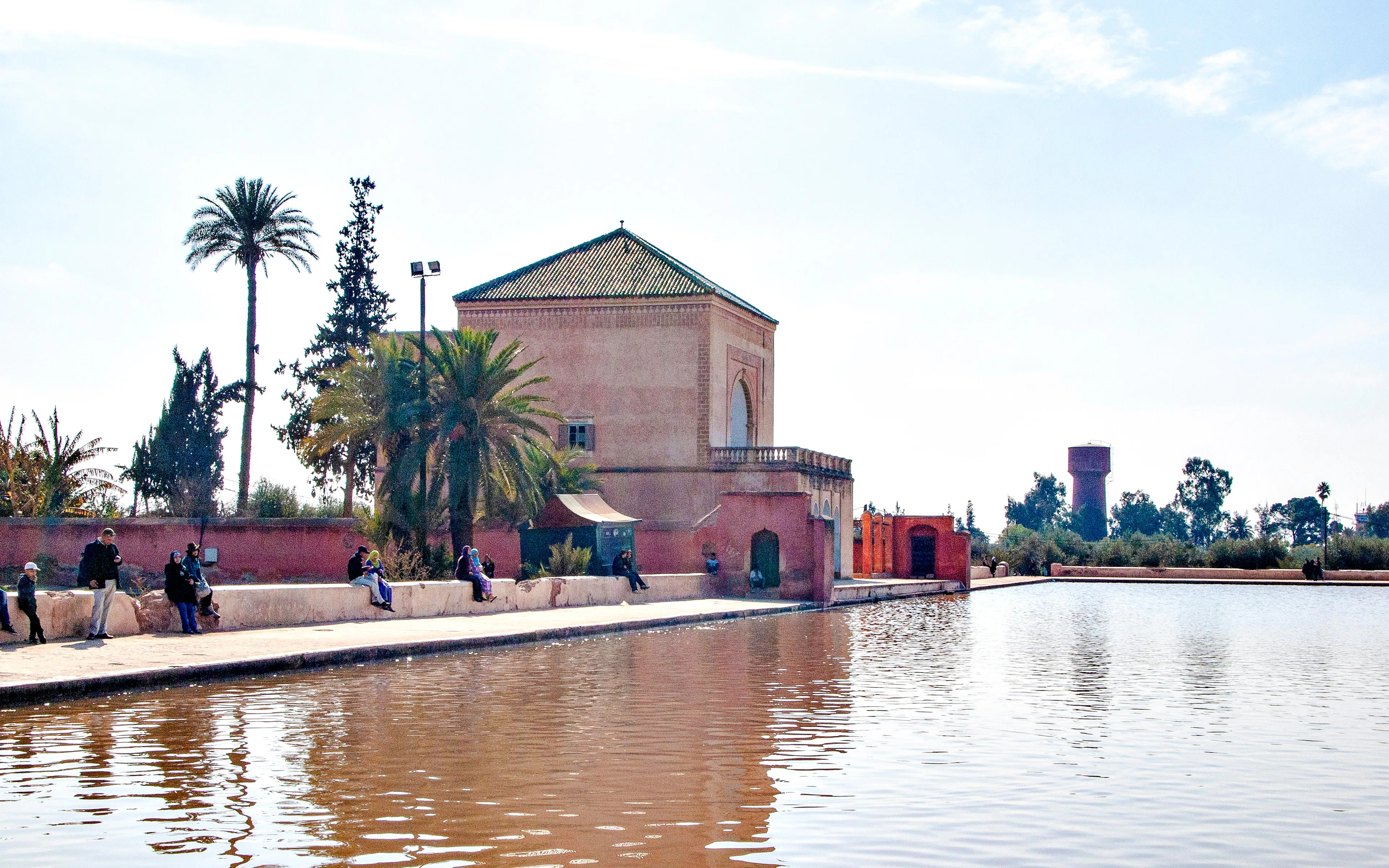
The reflecting basin
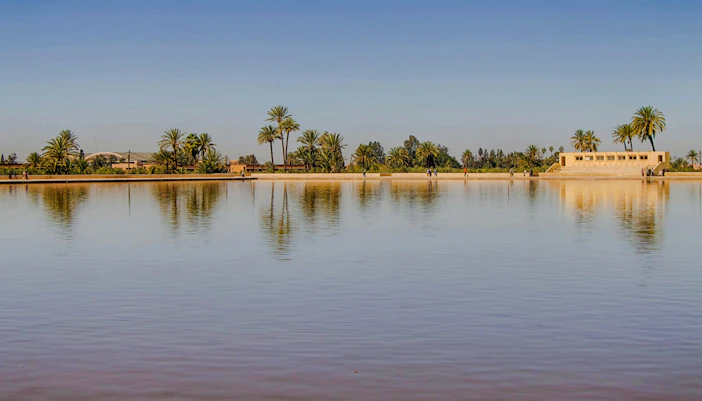
This huge reservoir is Menara’s visual anchor. Stand at the front edge for the cleanest reflection of the pavilion, especially early in the day when the water is calmer.
The pavilion exterior
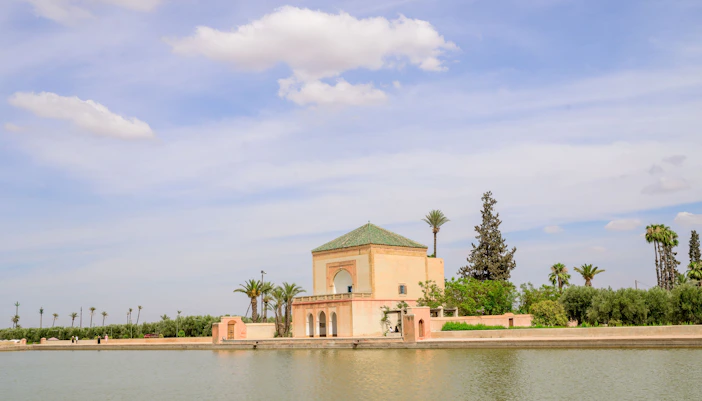
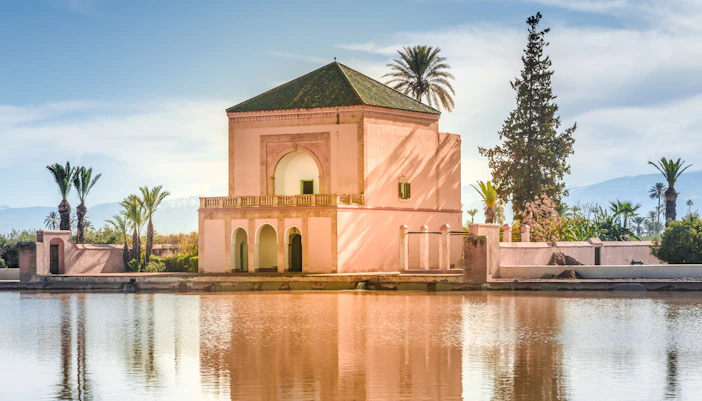
The ocher walls and steep green-tiled roof are what most people come for. From across the basin, the building reads almost like a stage set against water and sky.
The upstairs balcony
Inside, the pavilion is simple, but the upper level gives you a higher angle over the basin and groves. Go for the outward view, not for decorated rooms or displays.
The carp at the water’s edge
Near the embankment, you’ll often spot large fish gathering close to shore. It is a small detail, but it adds movement to an otherwise still, architectural scene.
The Atlas backdrop
When visibility is good, the mountains complete the composition. This is the most timing-sensitive part of the visit; haze often softens or hides the view by late morning in hotter months.
The local park atmosphere
Menara is not only a monument. On weekends and in cooler late afternoons, you’ll notice families strolling, picnicking, and using the grounds as a genuine public green space.
How to explore the Menara Pavilion
Budget 30–45 minutes if you want the classic view and a quick look inside, or 1–1.5 hours if you plan to walk part of the basin, linger for photos, and wait for changing light. Start by going straight from the entrance to the basin before wandering elsewhere; the first full view of the pavilion works best when the water is still and the scene is not yet busy with tour groups or weekend picnics. If you’re entering the building, do that after taking exterior photos, then continue along the basin edge for side angles and more open views toward the groves. Must-see: the frontal reflection across the reservoir, the green-tiled roof against the water, and the upstairs balcony view if you buy entry. Optional: a slower walk through the olive groves and farther along the basin adds 20–30 minutes and gives you more of Menara’s local park atmosphere. Self-paced works well if you’ve done a little reading beforehand, but a guide or audio adds value because on-site signage does little to explain the irrigation system or royal history.
Brief history of the Menara Pavilion
- 12th century: Almohad rulers establish Menara as a royal orchard and reservoir west of Marrakesh, using a large basin to irrigate olive groves.
- 16th century: Saadian rulers maintain the estate and its water system, keeping Menara tied to both cultivation and royal leisure.
- 19th century: The pavilion seen today takes shape under the Alaouite dynasty, formalizing the basin’s edge as a royal lookout.
- 1869–1870: An inscription records work on the pavilion, anchoring its present form in the late 19th century.
- Today: Menara remains one of Marrakesh’s best-known public landscapes, valued for its historic basin, pavilion, and long mountain views.
Who built it?
The Menara estate began under the Almohads, whose rulers used water engineering to turn land west of Marrakesh into a productive royal orchard. The pavilion visitors see today reflects later Alaouite patronage, when the site became not just agricultural infrastructure, but a ceremonial royal retreat. That decision was practical and symbolic at once: it turned a working reservoir into a stage for royal presence, landscape viewing, and controlled display beyond the city walls.
Architecture of the Menara Pavilion
Style
Materials
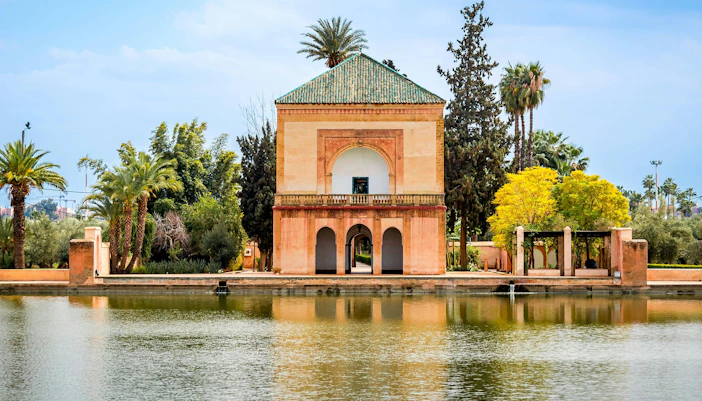
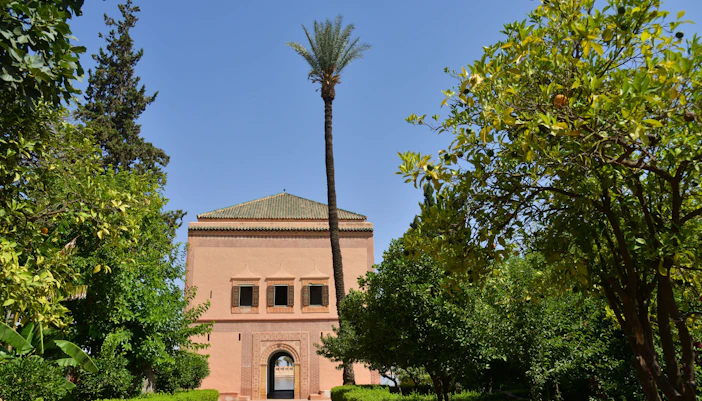
Ochre masonry and green roof tiles create Menara’s signature contrast, especially in late light when the walls warm up and the roof sharpens against the sky.
Hydraulics
The real feat is the basin itself, a vast reservoir that stored and distributed water for the orchards. You understand Menara best when pavilion and pool are read together.
On the ground
The architecture is about symmetry and distance. From the embankment, the building feels carefully placed for reflection, horizon lines, and measured approach.
Designer
No single architect is usually foregrounded. Menara is better understood as dynastic architecture shaped by royal patrons and engineers across Almohad foundations and later Alaouite rebuilding.
Who built it?
The present pavilion is usually associated with Alaouite royal patronage, especially 19th-century works that gave Menara its current silhouette. That decision was practical and symbolic at once: it turned a working reservoir into a stage for royal presence, landscape viewing, and controlled display beyond the city walls.
How Menara differs from Marrakesh’s other gardens
Menara works differently from Majorelle Garden, Bahia Palace, or the city’s denser historic sights. It is broader, barer, and less curated: you come for horizon, reflection, and breathing room rather than decorative detail. If Majorelle rewards close looking and color, Menara rewards timing and atmosphere. If the palaces feel inward and ornate, Menara feels outward-facing, with water, agricultural land, and mountain views doing most of the work. That makes it especially appealing later in a trip, when you want space more than another sequence of rooms.
Frequently asked questions about the Menara Pavilion
Yes, if you go for calm, views, and context rather than ornate interiors. Menara works best as a short scenic stop or sunset detour, especially if you want a break from the medina’s density and noise.
Most visitors need 45 minutes to 1 hour. If you only want the basin view and a few photos, 30 minutes is enough; add extra time if you plan to enter the pavilion or linger at golden hour.
Do not miss the frontal view across the basin, where the pavilion, roofline, and reflections align. If visibility is good, wait a few extra minutes for the Atlas backdrop; if you go inside, head upstairs for the balcony angle.
Yes for families and first-timers, especially as a low-pressure outdoor stop. Children usually enjoy the open space and fish, but the paths are exposed, facilities are limited, and midday heat can make the walk uncomfortable.
Early morning gives you the clearest light and the best chance of seeing the Atlas Mountains. Late afternoon is best for atmosphere and sunset color, while midday in hot months is the least rewarding for comfort or photography.
Partly. The grounds are flat, but the approach is long, exposed, and not especially smooth in places. The pavilion itself involves stairs for the upper view, so visitors with limited mobility may prefer staying at basin level.
The gardens themselves are free to enter, but the pavilion interior requires a paid ticket. Many visitors are happy with the exterior view alone, so you can decide on-site whether the upstairs balcony adds enough.
No special dress code applies, but modest clothing is a comfortable default in Marrakesh and practical for sun exposure. Bring water, sun protection, and steady shoes; the atmosphere is relaxed, but it is still a local public space.
Easily. Menara works well as a 1-hour stop before sunset, a pause between garden visits, or part of a half-day city circuit. It pairs best with sights that contrast its openness, such as a palace, museum, or souk walk.